
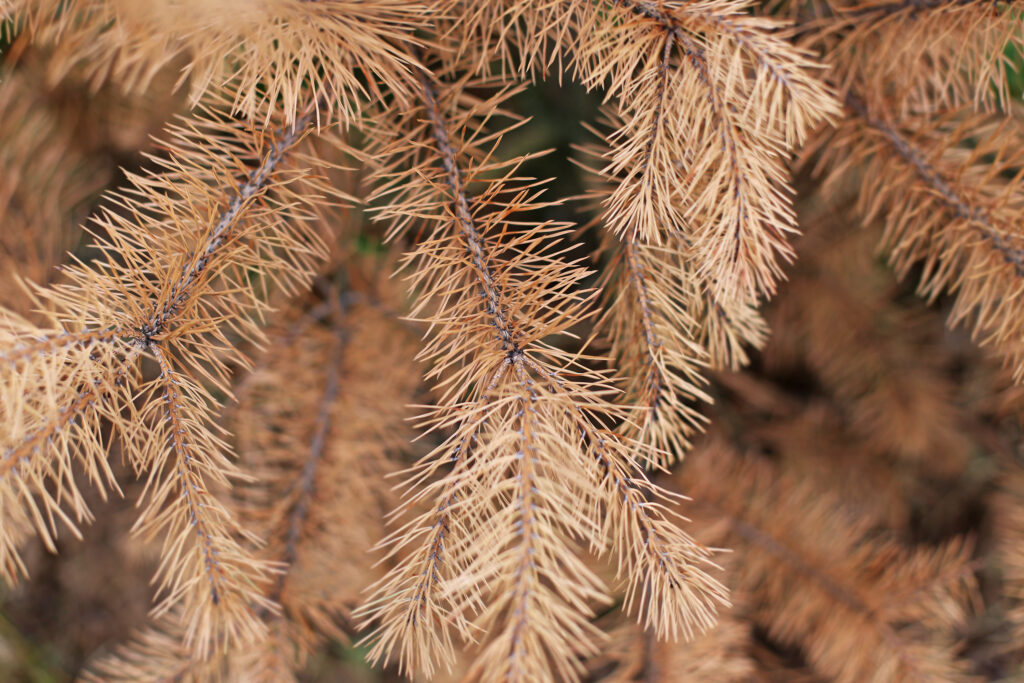
The Mid-Summer Evergreen Crisis in the Willamette Valley
Few sights are as alarming to an Oregon property owner as watching a towering Douglas fir—our iconic state tree—turn from vibrant deep green to a rusty, sickly brown in the span of just a few hot summer weeks. While deciduous trees naturally shed leaves in the autumn, evergreen conifers are built to hold their needles year-round. When top-down browning occurs during July, August, or September, it is rarely a benign seasonal event.
Across the Willamette Valley and the surrounding foothills, summer drought and sustained heat waves create a high-stress environment for timber. When moisture levels drop, native pests—specifically the Douglas-fir beetle (Dendroctonus pseudotsugae) and the flatheaded fir borer—seize the opportunity. Understanding how drought and beetle activity intersect is the first step toward protecting your property, managing risks, and knowing when it is time to call in a professional arborist.
The Biology: How Drought Triggers Beetle Infestations
Healthy Douglas firs possess a sophisticated natural defense mechanism against boring insects: pitch pressure. When a bark beetle attempts to burrow through the outer bark to lay eggs in the nutrient-rich inner phloem layer, a healthy tree forces sticky, pressurized pitch resin out of the entry hole. This effectively “flushes” or drowns the invading beetle before it can establish a gallery.
However, during prolonged Pacific Northwest dry spells, trees experience severe water stress. Without sufficient ground moisture:
-
Resin Production Plummets: The tree cannot generate adequate pitch pressure to repel invaders.
-
Chemical Signals Change: Drought-stressed conifers release stress volatiles (terpenes) into the air. Bark beetles possess specialized olfactory receptors that detect these distress signals from miles away.
-
Secondary Attacks Multiply: Once a single tree is compromised, emerging beetles emit aggregation pheromones, summoning hundreds of additional insects to attack the same tree and adjacent timber.
For a deeper look into how regional weather cycles affect conifer survival, read our comprehensive guide on Understanding Dying Douglas Fir: Causes and Solutions for Western Oregon Landowners.
4 Warning Signs of Bark Beetle Damage in Douglas Firs
Identifying a beetle attack early gives you the best chance to manage your timber before a dying tree becomes an immediate structural threat. Look out for these four telltale indicators:
1. Top-Down Canopy Browning (“Flagging”)
Bark beetles typically initiate their attack in the upper third of the tree canopy, where branches are thinnest and water stress manifests first. You will notice the needle canopy turning from dark green to lime green, then yellow, and finally a reddish-bronze color. This progression often spreads downward over the summer.
2. “Popcorn” Pitch Tubes & Boring Dust
Inspect the trunk bark closely. Successfully attacked trees often display small, reddish-brown to cream-colored sap blobs known as pitch tubes. If the tree was too moisture-deprived to produce pitch, you will instead find fine, reddish-brown boring dust (frass) accumulated in bark crevices or pooled around the base of the trunk.
3. Increased Woodpecker Activity
If you notice flickers, sapsuckers, or woodpeckers relentlessly flaking away outer bark on your fir trees, they are likely harvesting beetle larvae buried beneath. Heavy bark-flaking leaving pale patches on the trunk is a strong signal that the cambium layer is infested.
4. Structural Bark Sloughing
In advanced stages, the vascular system of the tree is completely severed. The bark begins to crack, loosen, and drop off in sheets, exposing dry wood underneath.
If you observe these symptoms alongside other red flags—such as mushroom growth around the root flare or trunk lean—review our checklist on 8 signs of a dead or dying tree to evaluate the severity of the decay.
Why Waiting Is Dangerous: Summer Hazards & Sudden Fall
Once bark beetles successfully girdle the inner cambium layer of a Douglas fir, the tree cannot recover. Water transportation stops completely, and the vast volume of wood dries out rapidly under the summer sun.
A dead, standing Douglas fir in Western Oregon creates two major liabilities:
-
Brittle Fuel in Fire Season: A bone-dry conifer acts as a massive vertical torch. In the event of a nearby brush fire or spot ember, dry needles and sap-less timber ignite almost instantly.
-
Structural Instability: As the wood dries, it becomes incredibly brittle. Large tops and heavy lateral branches can break off without warning, threatening nearby residential structures, outbuildings, fences, and power lines.
When beetle-killed trees sit through late summer, their wood fibers degrade rapidly. By autumn, attempting to climb or safely directional-fall a severely decayed fir becomes significantly more technical and dangerous.
Professional Assessment & Removal Solutions
When dealing with beetle-infested or dying timber, proactive removal is usually the safest and most cost-effective path forward.
At Santiam Tree Service, our ISA-certified experts conduct thorough on-site evaluations to determine whether a tree can be monitored or if immediate removal is necessary. When a tree is beyond saving, our crew utilizes specialized rigging, crane equipment, and precise directional dropping to remove the hazard cleanly without damaging surrounding landscaping.
If bark beetles have compromised a tree’s structural integrity on your property, scheduling timely tree removal in Albany prevents unexpected limb falls and mitigates pest spread to neighboring healthy conifers.
Don’t wait for late-summer winds to bring down a compromised conifer. Contact Santiam Tree Service today for a free, professional risk assessment.