
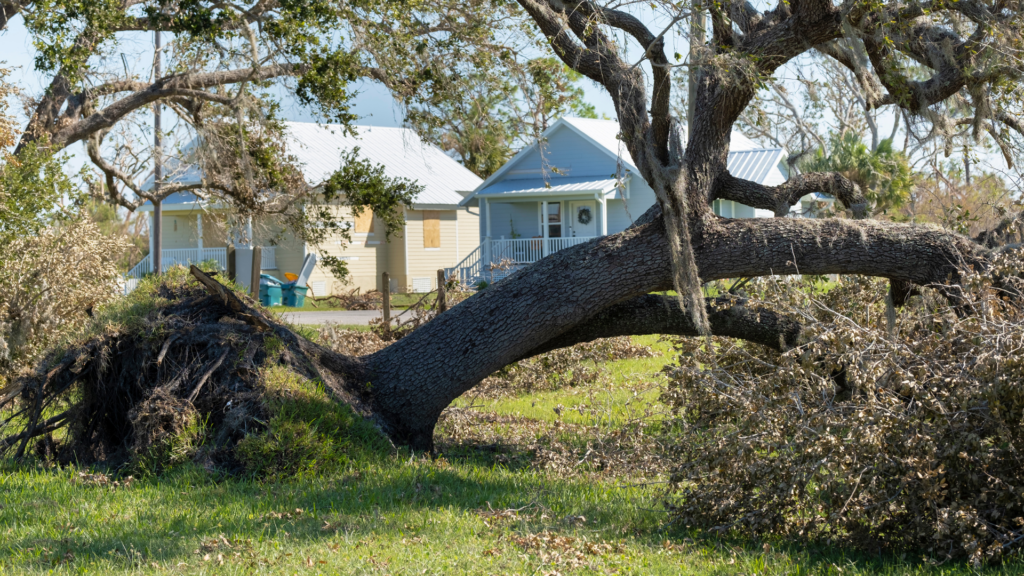
A lot of homes in Albany, Corvallis and Salem have a big Douglas fir or maple standing closer to the house than anyone would plant one today. When it’s a tree leaning toward your house, it’s hard to stop looking at it, especially once the winter storms start rolling through the Willamette Valley.
Most leaning trees are not about to fall. The ones that are usually give you warning signs first. This guide covers how to tell a stable lean from a dangerous one, why our wet winters make the difference matter, what you can do besides cutting the tree down, and when a tree leaning toward your house needs an arborist right away.
An old lean and a new lean are very different problems
Trees lean for ordinary reasons. A fir that grew up in the shade of the house or a neighbor’s canopy will reach toward open sky, and over decades that reach turns into a lean.
A tree that grew into its lean slowly has usually adapted to it. Trees add extra wood to support the side that carries the load. Conifers build it on the underside of the lean and hardwoods on the upper side. A lean like that can stay put for the rest of the tree’s life.
A new lean is a different story. If the tree was straight last year and isn’t now, something moved, and it’s usually the roots or the soil around them. That kind of lean is the one to take seriously.
A few ways to tell which one you have:
- Look at the shape of the trunk. A trunk that leans at the base but curves back toward vertical near the top has been correcting itself for years. A trunk that runs in one straight tilted line from the ground up is more likely a recent shift.
- Check old photos. Family pictures, real estate listing photos, or the street-level image history in map apps can show whether the tree looked the same five years ago.
- Ask the neighbors. People who have lived on the street for a while often remember when a tree “started going over.”
Warning signs that a lean is active
We covered storm damage signs in detail in our post on storm-damaged tree warning signs. For a leaning tree specifically, these are the ones that matter most:
- Soil cracking, mounding or lifting on the side opposite the lean, which means the root plate is starting to pivot
- Roots exposed or snapped on that same side
- A gap opening between the trunk and the soil
- A lean that changed after a windstorm, ice storm or long stretch of rain
- Mushrooms, soft wood or cracks near the base
You’ll see guides quote a specific number of degrees that’s “too much.” There isn’t a reliable magic angle. How far a tree leans tells you less than whether it’s moving and what it would hit if it failed.
Why leaning trees fail here in winter
Willamette Valley trees face a particular combination every winter. Many valley soils stay saturated for weeks at a time, and wet soil gives roots far less grip. When a strong wind arrives on top of that, a tree that’s already carrying weight on one side has the most leverage working against it.
Another situation we watch for is the edge tree. Douglas firs that grew up in a group shelter each other from wind. When a neighbor clears a lot or takes out part of a stand, the trees left standing suddenly catch wind they never had to handle. If trees near yours came down recently, keep a closer eye on the ones that remain.
Ice adds weight fast, and it rarely loads a tree evenly.
Is the tree too close to your house?
Distance by itself isn’t the real problem. A small ornamental tree three feet from the house can be perfectly fine, and a 90-foot fir 50 feet away can still reach the roof. A rough rule: a tree can hit anything within about its own height of the trunk.
When a tree is close, the day-to-day issues are usually smaller than people fear. Branches rub the roof and the gutters fill with needles every fall. Roots tend to damage sidewalks, driveways and old sewer lines more often than they damage a sound foundation.
The bigger question is what an ISA Certified Arborist calls the target: what’s underneath the tree if it fails. A lean over a bedroom, a driveway where cars park, or a play area raises the stakes far more than a lean over the lawn.
Hank McDonald, who owns Santiam Tree Service, is direct about how arborists think about it. A formal tree risk assessment (the ISA’s TRAQ process) puts the arborist on the hook for the call they make. If they say a tree will hold and it doesn’t, that’s on them. So when a tree over a house is truly borderline, Hank’s rule is simple: “When in doubt, cut it out.” That doesn’t mean every leaning tree should go. It means a borderline tree over a bedroom shouldn’t be left to chance.
Your options besides removal
Removal isn’t the only answer. Depending on what we find, the recommendation is usually one of these:
Monitor it. A healthy tree with an old, stable lean and nothing moving at the base may just need watching. Take a photo from the same spot every fall and every spring so you can compare.
Reduce the weight. Selective pruning can take load off the heavy side and clear branches away from the roof. Done correctly, it lowers the leverage the tree is fighting without hurting its health. Topping a tree does the opposite and creates weak regrowth.
Cable or brace it. Cabling and bracing support split-prone stems and heavy limbs. They won’t stand a leaning trunk back up, and they aren’t a fix for a tree whose roots are failing.
Straighten it (young trees only). A young tree that tipped in a storm can sometimes be staked back upright while it re-roots. A mature tree with a heavy root ball generally can’t be pulled straight, and trying can do more harm than good. Penn State Extension’s guide to what to do about leaning trees explains why re-anchoring rarely works once roots or soil have failed.
Remove it. When the roots or soil are giving way, the trunk is decaying, or the lean sits over something you can’t afford to lose, tree removal is the safe call. Next to a house, that means taking the tree down in sections and lowering pieces in a controlled way instead of dropping them. On one recent job, our crew took a 50- to 60-foot maple out from over a driveway, landscaping and irrigation lines in a single day without damaging any of it. When there’s no room to work at all, we bring in a crane and lift the tree out. [STAFF: confirm OK to reference the maple job without the client’s name or price.]
If the leaning tree is your neighbor’s
Start by talking with your neighbor. Share what you’ve noticed and any photos. An arborist’s written opinion can help both of you see the same facts, and it gives you a record if the situation gets worse.
Don’t have work done on a tree that isn’t yours without the owner’s permission. Rules about who’s responsible for a neighbor’s tree vary, so if you can’t reach an agreement, your homeowners insurance agent or an attorney is the right place for that question.
When it’s an emergency
Treat it as urgent if a tree has suddenly started leaning after a storm, the soil on the back side is visibly lifting, you hear cracking, or the tree is touching power lines. Keep people out of the fall zone and out of rooms on that side of the house. If lines are involved, call your power company first and stay well away. Then call for emergency tree service.
Frequently Asked Questions
Is a leaning tree going to fall?
Not necessarily. Many trees lean for decades without failing because they’ve grown extra wood to support the lean. A lean that’s new, growing, or paired with lifting soil or exposed roots on the opposite side is the kind that needs an arborist soon.
Can a leaning tree be straightened?
Young trees can sometimes be staked upright while they re-root. Mature trees generally can’t be pulled straight. For a large tree, the realistic options are monitoring, reducing weight, or removal.
Should I cut down a tree next to my house?
Only if it’s actually a risk. A healthy tree that’s close but stable may just need pruning. A tree with a new lean, decay at the base or failing roots near the house usually should come down. An on-site assessment by an ISA Certified Arborist is the way to know which one you have.
How close is too close for a tree next to a house?
There’s no single distance. A useful rule of thumb is that a tree can reach anything within about its own height. What matters most is the tree’s condition and what sits within that range.
Does insurance cover a tree that falls on my house?
Policies often cover damage when a healthy tree falls on an insured structure in a storm. Coverage can get complicated if the tree was dead or a known hazard, so check your policy and talk to your agent before there’s a problem.
Get an arborist’s eye on it
The best time to get a leaning tree looked at is before the worst of the winter wind arrives. Our ISA Certified Arborists will come out, look at the lean, the roots and what’s underneath, and give you a straight answer. Sometimes that answer is “leave it alone,” and we’ll tell you so. If it does need to come down, we haul everything away when we’re done.
Schedule a free estimate or call (541) 905-6674 in the Willamette Valley. In Portland Metro, call (503) 308-0006.