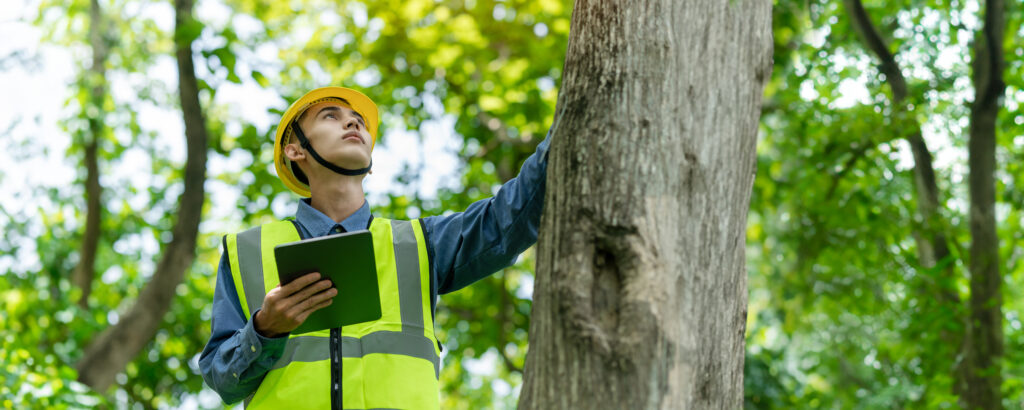
A tree doesn’t have to look dead to be dangerous, and it doesn’t have to look dangerous to be dying. If you’ve got a tree on your Corvallis property that’s leaning more than it used to, dropping bigger limbs than usual, or just doesn’t look right anymore, you’re stuck making a call without the training to make it. ISA Certified Arborists use a formal process called a tree risk assessment to answer that question the same way every time, whether the tree is in a backyard or towering over a driveway. Here’s what that process actually involves, and when it’s worth having someone come look.
What a tree risk assessment actually looks at
A tree risk assessment isn’t a gut check. It’s a structured evaluation built around three things: how likely the tree (or a part of it) is to fail, what’s underneath or nearby if it does, and how bad the outcome would be. Hank McDonald, owner of Santiam Tree Service, puts it simply: if an oak tree is out in the middle of a farmer’s field, the odds it hits somebody are low. If that same tree is next to a grade school where 500 kids walk by every day, the impact zone is a different conversation entirely.
That’s the part homeowners usually miss. A tree’s condition matters, but so does what’s standing underneath it. The same amount of decay can be a non-issue on one property and a serious liability on another.
Signs a tree needs more than a trim
Deadwood is the most obvious flag: big, hanging branches that have already died, especially ones with visible cracks, decay, or mushrooms growing at the base. In freezing weather those branches get brittle fast, which is part of why arborists pay closer attention to hazard trees heading into winter.
Cracks in the trunk or a split forming where two large limbs meet (arborists call this a co-dominant stem) are structural red flags, not cosmetic ones. So is soil that’s visibly lifting near the base of the tree or pavement that’s starting to crack nearby, both signs the root system is losing its grip.
Sometimes the damage isn’t visible at all from the ground. On a recent job, our crew brought in a crane to take down a large tree that looked structurally sound from the outside. Once the trunk was opened up, it was completely rotted through on the inside. That’s exactly the kind of thing a trained assessment is built to catch before it becomes an emergency instead of a scheduled tree removal.
Why access and location change the calculus
Two trees in identical condition can get two completely different recommendations depending on what’s around them. A tree that’s hard to reach, close to a structure, or growing over something valuable (a driveway, a pool, power lines) carries more risk in the “consequences” part of the assessment, even if the biology is identical to a tree standing in open space. That’s why an assessment is done on-site, not over the phone.
What happens after the assessment
The outcome isn’t always “remove it.” Depending on what the assessment turns up, the recommendation might be monitoring the tree over time, tree trimming to reduce weight and wind resistance, cabling or bracing to support a weak structure, or removal if the risk is too high to manage. Certified arborists tend to lean cautious for good reason: if you say a tree is safe and it isn’t, that’s a liability question, not just a judgment call. As Hank puts it, when in doubt, it comes out.
Frequently Asked Questions
-
How do you actually perform a tree risk assessment? An ISA Tree Risk Assessment Qualified (TRAQ) arborist inspects the tree on-site, checking the trunk, root zone, canopy, and any visible defects, then evaluates the likelihood of failure against what’s nearby that could be damaged or hurt. The result is a written assessment with a specific recommendation, not just a verbal opinion.
-
When is a tree risk assessment actually necessary? Any time a tree shows signs like large deadwood, trunk cracks, lifting soil, or a lean that’s gotten worse, or any time you’re planning construction, a property sale, or an insurance claim near a mature tree. Trees in high-traffic areas (near a home, driveway, or sidewalk) are worth assessing more often than ones out in open space.
-
Can a leaning tree be saved, or does it automatically need to come down? It depends on why it’s leaning. Some trees have leaned the same way for decades and are structurally fine. Others are leaning because the root system has failed, which is a different and more urgent situation. This is exactly the kind of thing a risk assessment is meant to sort out.
-
What’s the real difference between tree trimming and tree removal? Trimming addresses specific problem branches or shapes a tree for health and clearance. Removal is what happens when the tree itself, not just a branch, is the risk. A risk assessment is what tells you which situation you’re actually in.
-
Is a certified arborist required, or can any tree company make this call? Anyone can look at a tree and offer an opinion, but a formal risk assessment carries more weight when it’s done by someone with ISA Tree Risk Assessment Qualification, especially if the outcome ever needs to hold up for an insurance claim, a permit application, or a legal question about a fallen tree.
The bottom line
Corvallis has plenty of mature trees that have been standing for decades, and most of them are perfectly fine. The ones worth worrying about show real signs: deadwood, cracking, lifting soil, or a lean that’s changed. If you’re not sure which category your tree falls into, that’s exactly what a tree risk assessment is for. Our ISA Certified, TRAQ-qualified arborists can take a look and tell you plainly whether you’re looking at a trim, a monitor-and-wait, or a removal, before it becomes an emergency instead of a decision.