
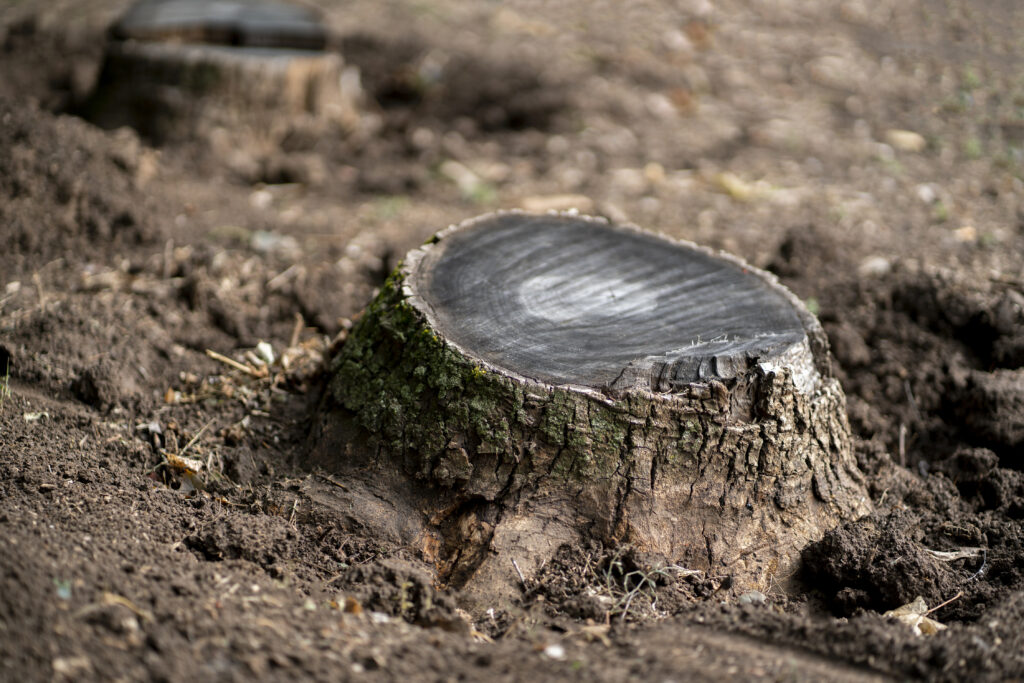
You took the tree down. Maybe a winter storm cracked a big-leaf maple in half, or an aging Douglas fir finally had to go. Now you’re left staring at a stump — and a decision. Do you grind it down or pull the whole thing out?
For most homeowners across the mid-valley — from Salem and Albany down through Corvallis, Philomath, Lebanon, Sweet Home, Monmouth, Scio, Jefferson, and Eugene — the answer is stump grinding. It’s faster, cheaper, and gentler on the surrounding landscape. But “most” isn’t “always.” If you’re planning a patio, replanting in the same spot, or dealing with a species notorious for sending up suckers, full stump removal is the right call.
This guide breaks down the differences so you can make the right choice for your property the first time.
Quick answer: grinding vs. removal at a glance
Stump grinding chips the stump down to 6–12 inches below the soil line using a self-propelled grinder. The roots stay in the ground and decompose naturally over a few years. Full stump removal extracts the stump and its main root ball using an excavator or backhoe, leaving a large hole that needs backfilling.
Grinding costs roughly 40–60% less than removal, takes a fraction of the time, and barely disturbs your yard. Full removal is more expensive and invasive but gives you construction-ready ground with virtually no regrowth risk.
What is stump grinding?
Stump grinding uses a machine with a rotating carbide-toothed wheel to shred a stump into wood chips. The grinder works in a sweeping motion, eating downward 6 to 12 inches below grade. When the job is done, the surface is level, the chips can be raked into garden beds or hauled off, and your lawn can be re-seeded the same day.
A skilled operator can knock out a typical residential stump in 30 minutes to two hours. The equipment is compact enough to fit through most side-yard gates, which matters in older Salem and Corvallis neighborhoods where fences are tight.
What stays behind: the entire underground root system. For Douglas fir, ash, cherry, and most fruit trees, that’s not a problem — the roots simply rot away over three to seven years. For a few species native or common to the Willamette Valley (more on those below), it can be.
What is stump removal?
Full stump removal extracts the stump plus the main root ball. It’s a different animal entirely. A crew brings in a mini-excavator or backhoe, digs around the stump, severs the major roots, and lifts the whole mass out of the ground.
The result is a hole — sometimes several feet wide and several feet deep — that has to be backfilled with quality topsoil and allowed to settle. The same residential stump that took an hour to grind might take half a day or more to remove fully, and the surrounding lawn will need restoration work afterward.
The upside: when the crew leaves, there’s nothing underground but soil. No regrowth potential, no root decay-driven settling years later, and no buried wood to interfere with future construction.
Side-by-side comparison
| Factor | Stump Grinding | Full Stump Removal |
|---|---|---|
| Typical local cost | $100–$400 per stump | $250–$900+ per stump |
| Time required | 30 min – 2 hours | 3–8 hours |
| Yard disruption | Minimal — small machine, contained mess | Significant — heavy equipment tracks, large hole |
| Roots | Left in ground, decompose 3–7 years | 70–90% extracted |
| Regrowth risk | Possible with willow, poplar, alder, some maples | None |
| Hole left behind | No — wood chips fill the cavity | Yes — requires backfill |
| Best for | Lawn restoration, gardens, mulch beds, replanting nearby | Construction, hardscaping, same-spot replanting, diseased trees |
| Wet-season feasibility | Generally workable | Difficult — saturated valley soils make excavation messy |
How much does stump grinding or removal cost in the Willamette Valley?
Local pricing varies, but most mid-valley homeowners can expect:
- Stump grinding: $100 to $400 per stump for most residential jobs. Many tree services charge a small minimum (often around $150) for the first stump and then per-inch pricing — typically $2 to $5 per inch of diameter measured at the widest point — for additional stumps on the same visit.
- Full stump removal: $250 to $900+, with very large stumps or restricted-access sites pushing higher.
Five factors drive the price more than anything else:
- Diameter. A 12-inch maple stump grinds out fast. A 36-inch Douglas fir takes serious time and dulls teeth quicker.
- Root complexity. Big-leaf maple and Oregon white oak develop wide-spreading root systems that complicate full removal. Conifers like Doug fir have a deep central root that resists pulling.
- Site access. Can the grinder reach the stump? Fenced backyards, steep slopes, and narrow side gates all add time. Tight access can force a smaller (and slower) machine.
- Soil. Willamette Valley clay is dense and compacts hard around roots, making excavation slower. Rocky fill near foothills (think Sweet Home or parts of Lebanon) dulls grinding teeth faster.
- Cleanup level. Leaving the wood chips on-site is cheapest. Hauling them away, backfilling the cavity with topsoil, or grading and re-seeding all add to the total.
If you have three or four stumps, ask about multi-stump pricing. Most tree services drop the per-stump rate significantly once the machine is already on-site.
When to choose stump grinding
Grinding is the right call when:
- You want to grow grass, plant a flower bed, or install garden beds where the stump used to be.
- You’re cost-conscious and need the cheaper option.
- You need the job wrapped up fast — often in a single visit.
- You want to keep yard disruption to a minimum, especially in landscaped areas.
- You have multiple stumps and want to clear them all economically.
- Equipment access is tight (older neighborhoods, narrow gates, mature landscaping you don’t want torn up).
For roughly 80% of Willamette Valley homeowners we work with, grinding is the right answer.
When to choose full stump removal
Full removal makes sense when:
- You’re building a deck, patio, driveway, shed pad, or anything that needs structural ground.
- You’re installing a fence post or in-ground utility line directly through the stump’s location.
- You want to plant a new tree in the exact same spot. Old roots compete with new ones for soil, nutrients, and space, and decaying wood under a sapling can cause settling.
- The tree came down due to disease — armillaria root rot, phytophthora, or a verticillium wilt — and you want infected root material out to protect surrounding trees.
- You’re dealing with a species that aggressively regrows from roots: willow, cottonwood, poplar, red alder, and certain maples are the usual suspects in our region.
Pacific Northwest considerations most articles miss
Most online guides to stump grinding are written for the Midwest or Southeast. A few Willamette Valley realities are worth flagging.
Doug fir and Western red cedar stumps are big. Mature conifers in our region routinely yield stumps 24 to 48 inches across. Both grinding and removal cost more for these, but grinding scales more linearly — extraction can balloon in cost on a 40-inch stump with a deep tap root.
Big-leaf maple and Oregon white oak spread wide. Their root flares can extend several feet from the trunk, which makes full removal a much bigger excavation than the stump diameter suggests.
Red alder and willow regrow. If you removed an alder along a creek or wet area in Scio, Jefferson, or anywhere in the valley bottom, expect suckers from the remaining roots unless you go with full removal. Same with the cottonwoods and willows common near the Willamette and Santiam rivers.
Wet-season soils are tough on excavation. From roughly November through April, Willamette Valley clay soils are saturated. Driving a backhoe across a wet lawn leaves ruts that take a full season to recover. Stump grinding is feasible nearly year-round; full removal is best scheduled for the drier months when ground is workable.
Armillaria and phytophthora. If a tree came down due to root rot — and we see plenty of it in the valley — leaving infected roots in the ground can give the pathogen a reservoir to spread from. In those cases, full removal is the safer long-term choice, especially if you have other mature trees nearby.
What about Oregon tree-removal permits?
Most rural and unincorporated Willamette Valley properties have no permit requirements for removing a tree on private land. Some cities — Salem, Corvallis, Eugene, and Albany all have municipal codes — regulate removal of street trees, heritage trees, or trees in environmental overlay zones. Stump grinding and removal after a tree is already down generally don’t require a permit, but always check with your city’s planning department if the original tree removal was in a regulated zone.
How long until I can plant grass or a new tree?
For grass: same week. Rake out the wood chips, top-dress with quality soil, and seed. The remaining underground roots won’t affect turf.
For a small ornamental tree or shrub: plant a few feet away from the original stump location, or wait a season or two for the wood chips to break down and amend the soil heavily.
For a replacement shade tree in the exact same spot: full removal is the way to go. Wood chip backfill robs nitrogen from the soil as it decomposes, and old roots can shoulder out new ones.
Frequently asked questions
Is stump grinding cheaper than removal? Yes — generally 40 to 60% cheaper. Local Willamette Valley grinding jobs typically run $100 to $400 per stump versus $250 to $900+ for full extraction.
Does stump grinding remove the entire stump? No. Grinding takes the stump down 6 to 12 inches below grade. The underground root system stays in place and decomposes naturally over three to seven years.
Will the tree grow back after stump grinding? For most species, no. Douglas fir, cherry, ash, oak, and most fruit trees won’t regrow once the stump is gone. A handful of species — willow, cottonwood, poplar, red alder, and some maples — can send up suckers from remaining roots. If you’re dealing with one of these and want a permanent solution, choose full removal.
How long does it take to grind a stump? Small stumps under 12 inches: 30 minutes or less. Medium 12–24 inch stumps: 45 minutes to 90 minutes. Large stumps over 24 inches: 1.5 to 3 hours, sometimes more for a wide Douglas fir or big-leaf maple base.
Do I need a permit to grind a stump in Oregon? No — stump work on private property after a tree is already down doesn’t require a permit in any of the mid-valley cities we serve. Permits typically only apply to live tree removal in regulated zones.
Can I rent a stump grinder and do it myself? You can, and rentals run $200 to $400 per day at most local equipment yards. The honest tradeoff: rental units are far less powerful than commercial machines, the learning curve is real, and the safety risks (flying debris, kickback, buried utilities) are nontrivial. For a single small stump it can pencil out. For anything bigger, hiring a pro is usually faster and cheaper once you factor in your time.
What do you do with the wood chips? Three options: leave them on-site for you to use as mulch (most popular), backfill the cavity with the chips and top with soil, or haul them away for an additional fee.
Can stump grinding damage my lawn or nearby trees? Grinding is contained to the target stump, so impact is minimal. A small ring of disturbed turf around the grind area is normal and reseeds easily. Roots of nearby healthy trees are not affected, which is one reason grinding is preferred when you want to preserve surrounding landscaping.
Get a free estimate for stump grinding in the mid-valley
If you’ve got a stump sitting on your to-do list — or several — we can walk the property, identify the stumps, and give you a no-pressure estimate the same week.
Santiam Tree Service is licensed, bonded, and insured, and we serve Albany, Salem, Corvallis, Lebanon, Sweet Home, Philomath, Monmouth, Scio, Jefferson, and Eugene, along with the surrounding Willamette Valley. Whether grinding handles the job or full removal is the smarter long-term move, we’ll tell you straight.