
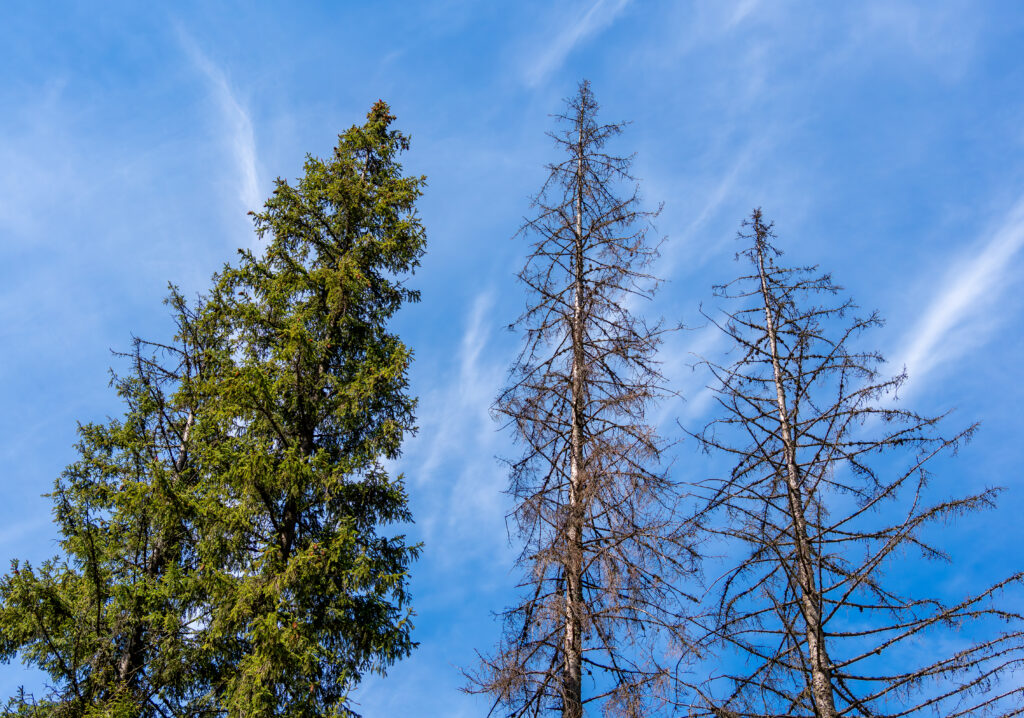
Mid-July through September is when Willamette Valley trees show the most stress from summer heat, and this year is no exception. A tree that looked fine in June can start thinning at the top by August if it isn’t getting enough water, and by the time the damage is visible, some of it is already done. Here’s how much water your trees actually need this time of year, how to apply it correctly, and when watering alone isn’t enough.
What drought stress looks like before a tree becomes an emergency
Drought stress rarely shows up as a single obvious sign. It’s usually a thinning crown that starts at the top of the tree, leaves that are smaller or more scorched at the edges than normal, or branches dropping leaves early in a section that used to stay full through September. Conifers like Douglas fir often show it as needles turning a dull yellow-green before browning from the inside out.
None of these signs mean the tree is dead. They mean it’s under stress and the next few weeks matter. If you want the full list of signs that do point to a dead or dying tree, we cover that in detail in How to Tell If a Tree Is Dead or Dying. This article is about the step before that: what to do once you notice a tree struggling, while it’s still saveable.
How much water your trees actually need
Oregon State University Extension recommends the equivalent of one inch of rainfall per week for Willamette Valley trees from June through September, with the heaviest need falling in mid- to late summer when natural rainfall all but stops. For established trees, that works out to roughly five to ten gallons of water per inch of trunk diameter, applied once or twice a week rather than a little bit every day.
Daily light watering does more harm than good. It keeps the top few inches of soil damp while the deeper roots that actually support the tree stay dry, and it can encourage roots to grow shallow instead of reaching down where the tree can find moisture on its own once the rain returns. Water deeply and less often instead. A soaker hose laid in a loop under the branch spread, left running for a couple of hours, gets water down to the 8 to 10 inch depth where it does the most good.
Newly planted trees are the exception. Give them two to three deep waterings a week while their root systems are still shallow and establishing, typically for the first one to two years.
Mulch is doing half the work
A 3 to 5 inch layer of wood chips or arborist mulch spread under the canopy, kept a few inches back from the trunk itself, slows evaporation the same way a lid slows a pot from boiling dry. It’s one of the simplest things a homeowner can do, and it’s the one most often skipped. If your mulch layer has thinned out since spring, topping it off before the hottest weeks hit is worth the twenty minutes it takes.
When to stop watering
Cut off supplemental watering by the end of August. This surprises a lot of homeowners who assume more water is always better, but many species, Douglas fir and bigleaf maple included, need some drought stress in early fall to start hardening off for winter. Watering into October can leave a tree less prepared for the first cold snap, not more.
Trees at higher risk in the Willamette Valley and Portland Metro
Douglas fir and western red cedar tend to show drought stress earlier than broadleaf species like oak or bigleaf maple, especially on shallow or compacted soil common in newer Albany and Portland Metro subdivisions. Trees within a few years of construction work nearby are also at higher risk, since root systems disturbed by grading or trenching can’t pull in water as efficiently even years later.
Watering and mulching solve most drought stress on their own. What they won’t fix is a tree that’s already showing dieback in more than a quarter of its crown, has fungal growth at the base, or has a lean that’s gotten noticeably worse. That’s when it’s worth having an ISA Certified Arborist take a look before the tree becomes a bigger problem, or a hazard, than a watering schedule can solve. We cover species-specific dieback in more depth in Understanding Dying Douglas Fir.
The bottom line
Most drought stress in Willamette Valley and Portland Metro trees comes down to inconsistent watering and thin mulch, both of which are fixable in an afternoon. Deep, infrequent watering through late August, a solid mulch layer, and a second look at anything showing serious dieback will carry most trees through the dry months. If a tree on your property looks like it’s past the point watering alone can help, Santiam Tree Service’s ISA Certified Arborists can assess it and tell you straight whether it needs treatment, monitoring, or removal.
Willamette Valley: (541) 905-6674 | Portland Metro: (503) 308-0006 | Schedule a tree health assessment