
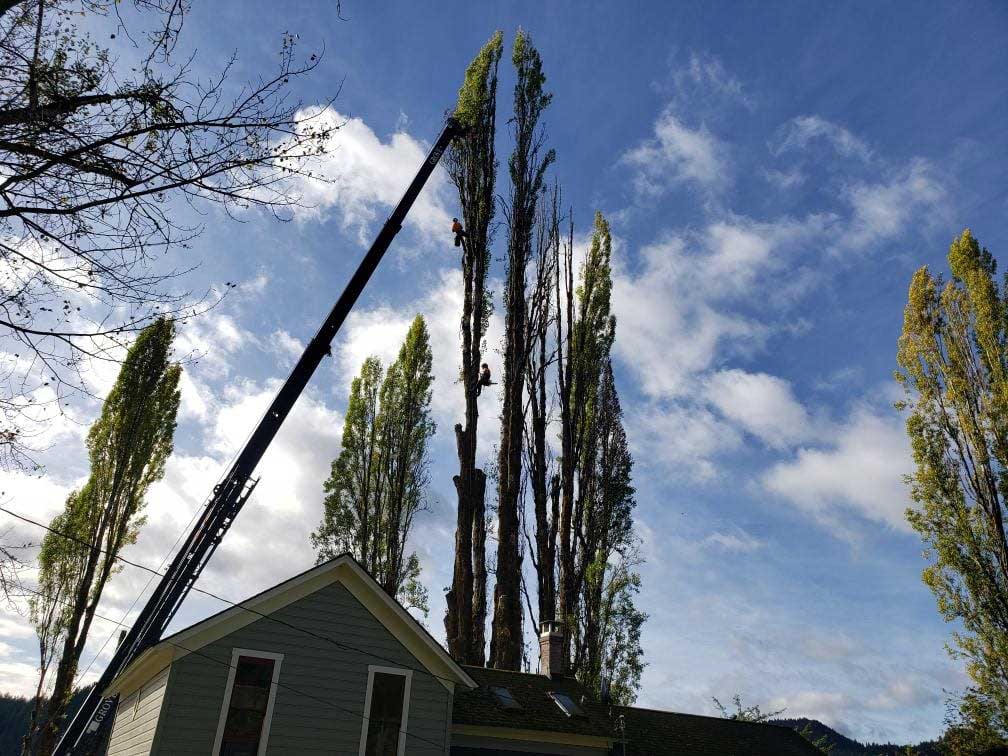
A tree that looks sick in January might be perfectly healthy just dormant. But a tree that’s actually dead is a different story. Dead and dying trees are unpredictable hazards. Branches can drop without warning, and a full tree failure during an Oregon windstorm can cause serious damage to your home, fence, or anyone standing nearby.
Knowing how to tell if a tree is dead or dying could save you a lot of trouble. Here are eight signs to check before you call a professional and what to do when you find them.
The Difference Between a Dead Tree and a Dormant Tree
This is the question homeowners ask most often in late fall and winter: is my tree dead or just dormant?
Dormancy is a natural survival strategy. Deciduous trees, maples, oaks, alders, and others that lose their leaves go dormant every winter. During dormancy, they stop growing and conserve energy. From the outside, a dormant tree and a dead tree can look nearly identical.
The difference is in the details. The eight signs below will help you figure out which one you’re dealing with.
8 Signs Your Tree May Be Dead or Dying
1. The Scratch Test
This is the fastest and most reliable field test. Find a small twig or young branch and scratch the outer bark with your fingernail or a pocket knife. Look at the layer just underneath.
- Green or white beneath the bark: The tree is alive in at least that section.
- Dry, brown, or tan beneath the bark: That branch is dead.
Do this in several spots — on small outer branches and closer to the trunk. A tree can have dead branches but still be very much alive. If the scratching reveals dry brown tissue right at the trunk, that’s a serious warning sign.
2. Brittle, Snapping Branches
Healthy branches flex. Dead branches snap.
Walk around the tree and gently bend a few small branches near the ends of the canopy. A living branch bends without breaking. A dead one will snap cleanly, often with a dry crack.
If most of the branches you test are brittle and snapping, the tree has lost a significant amount of live tissue.
3. No Buds in Spring
In Oregon, spring comes early often February or March for species like bigleaf maple and red alder. If your neighbors’ trees are budding out and yours isn’t, that’s meaningful.
Look closely at the tips of branches for small buds starting to swell. No buds, no leaf-out. If you’re past mid-spring and a deciduous tree still has bare branches, it’s time to take the tree seriously as a concern.
Evergreens like Douglas fir don’t follow the same spring bud pattern, but should show consistent needle growth and green coloring. Yellowing, browning, or dropping needles on a Douglas fir are warning signs worth investigating.
4. Bark That’s Falling Off
Bark is the outer protective layer of a living tree. Healthy bark stays attached. Dead bark peels away.
If you notice large sections of bark sloughing off without new bark forming underneath, the tree is almost certainly dead or dying in those areas. Look for:
- Sections of trunk with bare, dry wood exposed underneath
- Loose bark that lifts easily with your hand
- No green cambium layer visible beneath the bark
Some bark naturally sheds in strips this is normal for species like paper birch and sycamore. But for most trees, large-scale bark loss is a warning sign.
5. Fungal Growth at the Base or on the Trunk
Oregon’s wet climate is excellent for fungal growth. Shelf fungi (also called conks or bracket fungi) growing out of the trunk or at the base of a tree are a serious red flag.
These fungi don’t just grow on dead trees, they cause the decay that kills them. By the time you can see shelf fungi with the naked eye, the internal wood may already be significantly rotted. This type of internal decay weakens the structural integrity of the tree and dramatically increases the risk of failure.
If you see mushrooms or shelf fungi growing on or immediately around your tree especially during winter or after heavy rain have a certified arborist assess it.
6. Leaning That Wasn’t There Before
Trees lean for many reasons. A lean that’s been there since the tree was young isn’t necessarily a problem. But a lean that’s developed recently or is getting worse is different.
Sudden leaning often means root failure or soil heaving. After a saturated Oregon winter, root systems in clay-heavy soils can lose their grip. A tree that leans toward a home, driveway, or street after rain or wind is a hazard that warrants immediate attention.
Check for soil mounding or cracking at the base of the trunk on the side opposite the lean this can indicate that roots are pulling out of the ground.
7. Cracks, Cavities, and Splits in the Trunk
Deep vertical cracks, large hollow cavities, or splitting at major branch junctions (called codominant stems) are structural warning signs.
A crack doesn’t automatically mean a tree is dead, but it does mean the tree has a mechanical weakness. Combined with other signs — deadwood, bark loss, fungal growth a cracked or hollow trunk tells you the tree is unlikely to be sound.
Cavities that house wildlife (squirrels, birds) are sometimes manageable with proper tree care. But cavities that extend deeply into the trunk and have no solid wood surrounding them are a different concern.
8. Dead Branches Concentrated at the Top (Dieback)
“Dieback” is the progressive death of branches starting at the crown and working downward. If you look up at your tree and notice the top third or half has bare, dead branches while the lower canopy still looks green, the tree is in serious decline.
In Oregon, crown dieback can be caused by root damage, soil compaction, construction impact, drought stress (yes, even here), or disease. Regardless of cause, significant crown dieback in a large tree near structures is a hazard that needs professional evaluation.
Dead Tree vs. Dormant Tree: A Quick Reference
| What You See | Likely Dormant | Likely Dead |
| Scratch test reveals green tissue | ✅ | — |
| Scratch test reveals dry brown tissue | — | ✅ |
| Flexible branches | ✅ | — |
| Brittle, snapping branches | — | ✅ |
| Buds present in spring | ✅ | — |
| No buds after spring leaf-out | — | ✅ |
| Bark firmly attached | ✅ | — |
| Bark falling off, bare wood exposed | — | ✅ |
| No fungal growth on trunk | ✅ | — |
| Shelf fungi or mushrooms present | — | ✅ |
Is a Dead Tree Always a Problem?
Not always but usually.
Dead trees left standing (called “snags”) do provide wildlife habitat. In a forest or natural area, a standing dead tree can be left for years. In a yard, near a home, over a driveway, or along a fence line, a dead tree is a liability and a safety hazard.
Dead wood becomes brittle and unpredictable. Oregon’s wind, ice, and rain events are hard on dead trees. Branches drop. Whole trees fall. If a dead tree is anywhere near a structure, a vehicle, a utility line, or a place people walk, it needs to come down.
When to Call a Certified Arborist
You don’t need to wait until you’re certain a tree is dead. If you’re seeing two or more of the signs above especially fungal growth, crown dieback, or recent leaning call a certified arborist for an assessment.
An ISA-certified arborist can evaluate the full picture: internal decay that isn’t visible from the outside, root health, species-specific risk factors, and whether the tree has any realistic chance of recovery.
Sometimes a tree that looks half-dead can be saved with proper pruning and care. Sometimes a tree that looks okay from a distance has serious structural failure hiding underneath the bark. Professional eyes make the difference.
Santiam Tree Service provides free estimates for homeowners in the Corvallis, Albany, Eugene, and Willamette Valley area. Our ISA-certified arborists can assess your trees and give you a straight answer about what you’re dealing with and what your options are.
Contact us today to schedule your free tree assessment